

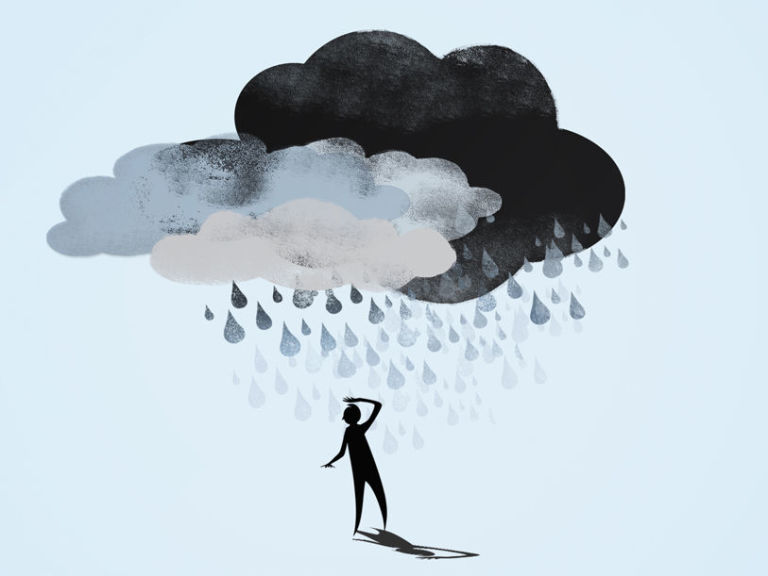
DISCLOSURE: This post will discuss depression both at a factual level and at a personal level. If this kind of content is in any way upsetting to you to read, please close the post without continuing to read.
I’m not certain that anyone who has lived or lives with depression is all that excited that depression gets its own awareness month. I suppose that November is the logical month, since this is the time of year when S.A.D. (Seasonal Affective Disorder) occurs for some people. S.A.D. is psychologically labeled as a form of depression. Its onset is thought to be because less daylight may trigger a chemical change in the brain leading to symptoms of depression.
S.A.D. became an actual diagnosis in 1984. However, although at the time it was not named nor recognized, I first experienced the symptoms of it in fall of 1975. I wasn’t ever naturally perky, vivacious and outgoing, so I only knew that I tended to feel noticeably melancholy, and I adjusted to the feeling so that it became ‘normal’. While I did feel more “down” than usual, it wasn’t a big deal because I didn’t live my life as “up”. It was only when the feeling started occurring annually, usually sometime between the last week of September and the first week of October, that I recognized the pattern.
I wasn’t officially diagnosed as suffering through S.A.D. until I was in my early 50s, when I ended up with a doctor who listened to me mention the annual onset of melancholy as I had told every new doctor who had previously undertaken my care. When Jenn listened, heard me and nodded in understanding, labeling what I went through with a name and assuring me that many people suffer in the same way, I was finally able to understand it and begin to accept it. I learned to bundle up and get outside on sunny days from September through February, raise my face up directly at the sun, close my eyes and just be for a few moments. Now, every year, I recognize the melancholy at its onset, and know that it’s temporary and it’s not a bad reflection on me. And people don’t notice the mood I’m in because I’ve perfected wearing the mask of happy, perky, etc. in public, a mask I needed to form and wear in order to survive 20+ years on the front line in the hotel industry.
I’ve had a few times in my life where I was very depressed, but those were always times when there was a BIG change in my life that impacted me enough to struggle with whether I wanted to keep going. My friend Melissa, who also suffers with clinical depression (100% chemical imbalance in her brain), once said, “I don’t want to kill myself. I just don’t want to go on living this way anymore.”
Exactly! I have no desire to commit suicide, and to be honest, here is probably the biggest reason: There was a man in the church my family moved to after we were all adults. It was a larger church than the small one I grew up in (where everybody knew everybody else’s business). I was living about 35 minutes from “home”, but I tried to join my mother at least once a month for a church service. At the very first service, I noticed a man wearing a blue mask and I asked my mom why with curiosity. The answer was nothing I would have expected. This man wore this mask whenever he was around people, because he had terrible scars on his lower face and mouth area. And those scars came from the fact that he attempted to swallow a gun but didn’t succeed. Think about that again – a man put a gun into his mouth with the intention of committing suicide, pulled the trigger, and somehow the bullet went down in aim far enough to slip between two vertebrae in his neck. His face and mouth were so disfigured because he hadn’t pushed the gun very far into his mouth and the recoil caused the injuries.
Yes, that’s a horrible story to know, but what I came away with from it is that suicide can fail. Truly, I realized that if I were to attempt – and fail – it would be the ultimate way in which I could disappoint my parents, and I knew the guilt of that would eat me alive. So, I have made a pledge that I will not commit suicide and have even said to my PCP, “I won’t commit suicide, because with my luck, I’d fail.”
In 2017, I suffered what would be diagnosed as a major depressive episode. (Again, I’ve never been a perky extrovert, but I never thought of myself as depressed, either!). It was the end of January when I actually could feel that I was depressed – not suicidal – but really doing nothing more than barely existing. Personal hygiene became something I cared nothing about. I didn’t read, didn’t watch TV, ate sporadically and mostly just sat. Melissa’s words came back to me – “I just don’t to go on living this way.” And yes, there was a small difficult emotion playing into that time – an action by someone that intellectually made sense, but emotionally made me feel completely forgotten and uncared for.
As a result of that episode, I now take an antidepressant in addition to the one I take for S.A.D. And I still have issues with motivation at times, but I recognize now that the lack of being motivated for physical activity is 90% because of my health, and not my mental state. I can lay awake while I wait for Mr. Sandman and actually see myself doing a whole bunch of things when I get up the next day. Well, you probably have heard the saying that “the path to hell is paved with good intentions…”
That’s the Readers Digest Condensed Version of my personal experience with depression. Now on to some facts I’d like to share:
Depression is considered a high-functioning mental illness. High-functioning mental illness is a term used to describe those living with a mental illness that most people don’t detect.
Approximately 3.8% of the population experience depression, including 5% of adults (4% among men and 6% among women), and 5.7% of adults older than 60 years. That means that approximately 280 million people in the world suffer from depression. It’s interesting to note, however, that only 7 million of that population have been officially diagnosed and are, or have, received treatment for that diagnosis.
When I was growing up, there was a stigma associated with needing help with the feeling of depression, whether through therapy, medication or both. People who couldn’t seem to deal with things that life threw at them without needing help were thought to be weak. And at a time in society where outward impressions were a big priority, people didn’t seek help because they didn’t want to risk having someone(s) in their peer group finding out and thus being labeled as weak.
There are two basic types of depression. Depression that stems from a traumatic event or events can be helped by spending time with a qualified therapist who can help work through the many and varied emotions around a specific event(s). Some may only need short-term therapy sessions to understand the emotions behind the depression and learn to accept and manage those emotions. For some, that therapy opens up a can of hidden emotions from other events or situations, and the therapeutic sessions may run for a longer time. Others may suffer with a chemical imbalance within the brain often brought on with a change in hormonal balance within the body or faulty mood regulation within the brain. Spending time with a qualified therapist can help determine if the depression is emotionally based or chemically based. If chemically based, you will be referred to a psychiatrist who will be able to work with you to find medications that can help balance the brain’s chemical measurements and bring relief.
These are facts that many people have heard or heard enough about to recognize depression as an illness. But it seems that their recognition is as far as their grasp goes. Depression can be well-hidden from those around us. Those of us who are diagnosed but still able to function in daily life, do tend to keep the diagnosis well-hidden, because the diagnosis itself makes us feel vulnerable.
I am clinically diagnosed with depression, and only because I annually experience S.A.D. to some degree and have had an episode of major depression (documented by my request in my medical chart), am I willing to accept (more or less) the diagnosis. But I don’t feel depressed. Oh, I may have a moment now and again when something happens that makes me sad, but I don’t carry around depression on my shoulders. When asked by someone why I’m not more social, it’s truthful to say that I am most content when I am by myself. To be around strangers for a specific reason sounds like a waste of time for me, because it doesn’t allow me the opportunity to develop a one-on-one relationship with any of those people around me. Also, despite my own issues (and I have a lifetime subscription to issues), I am comfortable enough with who I am to be comfortable by myself. For example, there is a loved one in my life who constantly needs to have conversation going around him/her, and that conversation is pure surface and trivial matters. When we are in a car, I am quite content to enjoy the silence – both to keep me more focused as a driver as well as to let me enjoy the scenery. But within less than 2 minutes of silence, this person will again speak up and share another unimportant story. It is apparently important that I know that a mutual friend won $50 playing the lottery or bowled a perfect 300 game in the bowling league that person belongs to or caught a 15″ catfish when he went fishing (last week, yesterday, doesn’t matter when). It is that important to this person to have conversation – as equally as important as my desire for silence – and so I listen, albeit not very closely, because I have nothing to add. However, knowing that all relationships require compromise, I say nothing about how much I dislike constant conversation like that because I believe it makes that person feel more comfortable in conversation than I am discomfortable with it.
But again, my appreciation of silence and my contentment of being alone doesn’t mean I’m depressed in some way. That is just how my life is, and I enjoy my life by giving myself those things.
This is getting long, but there are two more points I want to make. The first point is how people react to finding out that a person is experiencing an episode of sadness (not only just depression). When people say, “Let me know if you need anything”, it’s an empty platitude that allows that person to move on and go back to his/her own life without guilt. Even without being a depressive, I have never found it comfortable, much less easy, to reach out for help, and especially when I need it. I can remember incidents where I found it uncomfortable as far back as my teenage years, and I’m pretty sure I’ve gotten even less willing as time goes on. I know this relates back to my childhood, when my parents strongly reinforced the idea of not letting them see you sweat, don’t let them see that you can’t accomplish anything you think that they think you should be able to do. Because of that, I tend not to mutter the words of being called on if needed, and instead tend to show up fairly actively in just checking in once or twice a week. I also include in that checking in the question, “What can I do to help you today, even though you’d rather not admit that someone doing something for you will make you feel ‘weak’?” I might show up every 10 days of so with that person’s favorite donut and a cup of coffee, or with a ready-to-heat up meal I make that I know they enjoy. It’s one thing to offer to make yourself available to reach out if they need something; it’s another thing to do something that you know might be appreciated without waiting to be asked.
And the other point I have to make is, when there is a suicide, the words like, “If only he/she had talked to me” or “I wish he/she would have come and talked to me” make me cringe!
I know the statement above to be true. There are multiple reasons to remain silent about our feelings. I have chosen to speak about these feelings to others from time to time, and while they may listen, they can’t grasp the emotions because they’ve never experienced them (or never equated what they might be feeling as a negative emotion). Have you ever had a “meh” day? “Meh” being described where there was very little energy physically, mentally and/or emotionally that you foresaw in your life for the next 24 hours? If you’ve ever felt like you had a day that meant nothing good was headed your way, nor did you think there was anything bad headed your way either, then you’ve had a “meh” day. And if you can relate to what a “meh” day feels like, just multiply that times infinity, and that’s why depression feels like for me. There are things that make me smile, times where I’m in a moment and having a fabulous time, but most of the time, my days are “meh”.
And please understand this, which is a difficult pill to swallow: Suicide is a choice. (A Ph.D. I worked with said that to me because of a patient who would sometimes call and if that doctor was in session and couldn’t take the call, would make comments about committing suicide if she wasn’t that important to him.) Hell no, it’s not a smart choice, and that choice doesn’t happen overnight. As humans, we can suggest and advice people we care about to make a different choice, but we have no capacity to make that person change his/her choice. “If only” doesn’t erase what happened. Again, to me, that comment feels self-satisfying, a way to stave off any guilt be suggesting that if you had been in the picture, maybe things would have turned out differently. Think about it logically, and committing suicide is done without conversation beforehand and always when the person is alone.
This has gotten way longer than I thought it would be, despite having read the draft multiple times and edited some out each time. This may be boring to read to some or many of you. But…if I’ve given a deeper understanding of depression from my own experiences, or if I’d made you look at yourself or others in your life armed with this knowledge and understanding, then my mission has been accomplished! And, yes, you are getting this blog on the last day of November, but I’ve probably given 10 or more hours in writing and reading and re-reading and editing and re-reading, etc. to it, so it’s taken me a while to get it ready to publish. (If there were 31 days in November, you’d probably still get this on the last day of the month because there are still ways to edit this that I’ve run out of time to do!)
 Ramblings and Ruminations